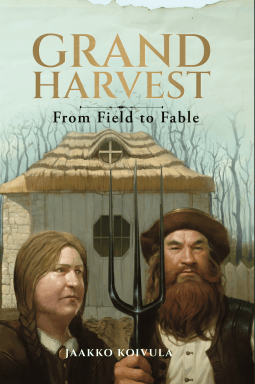
The setting this novel takes place in is a creative project formed from an RPG campaign, story telling and LARPing. (According to various descriptions I’ve seen about it online.) From this, I take that it a shared universe project of some variety. (Maybe. It seems to have a singular writer, though a singular writer who wants to include everyone who assisted in his development of his setting.)
Plot A involves the town of Böndelheim, which is populated by a mix of humans, and dwarf refugees. The entire town despises magic users due to some extreme generational trauma that the dwarves accidentally passed on to the humans in the population. (The dwarves have very good reason hate magic users: mostly due to their community having been enslaved by same.) When there’s an unexpected bumper crop of wheat, the entire town decides to tear out their original crops and plant wheat. No one suspects anything’s wrong with the wheat, or that magic could be involved–yet it’s clear that all is not well in Böndelheim. Animals are sickening, and the townsfolk are somehow going hungry despite the endless fields of wheat.
Plot B takes a while to appear, but involves Ash and Dale, two mages who have been assigned with figuring which runes still work the way they’re supposed to, or discovering what they do now. Their efforts have so far been unsuccessful until they encounter a loaf of bread. The properties of this bread are so unusual they end up going on an expedition to seek out the source of the grain that made the bread. Their attention is eventually drawn to , and it’s strangely abundant wheat fields…and very angry, very suspicious villagers, many of them with C-PTSD related to magic-users.
Grand Harvest has a very slow pace! It’s clear the author is trying to write from the experience of mundane commoners: traders, artisans, farmer and so on. What would be the NPC contingent in an RPG. Trying, but not quite succeeding. Unfortunately, Böndelheim feels like walking through the set of of a Pseudo European Fantasy Village, not like an actual community. I had no feel for the characters and kept forgetting who certain characters were supposed to be.There is some attempts at introduction by immersion, but I feel that there needed to be more infodumping here, not less. Characterization is very sparse, though the implied culture of the combined dwarf and human village has a lot of potential.
Still, there’s a lot of potential to the setting, which has some interesting worldbuilding. The writer is effective at conveying trauma and inserting the reader into the flash back or dissociation a character experiencing. Some of the humor fell flat with me due to being lighter and more silly than the surrounding story. The writer is capable of going darker, but didn’t seem to have a good feel for when or how to apply light or dark humor. So I recommend the book, in the sense that I would like to see more from this writer.
This review was based on galley copy from NetGalley.


Leave a comment