
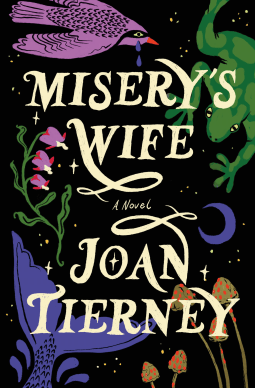
Misery’s Wife is a retelling of the Portuguese fairy tale, “What Came of Picking Flowers.” (I had to do some poking around to find out what folk tale the book was based on. It was not named in the book summary.) It’s something of a “Bluebeard” but with elements from other tale types. (Note: fairy tales tend to fall into rough categories with specific elements/themes in common.) It takes place in a post-apocalyptic, post-ecological collapse world in which the natural world has either gotten much, much bigger or else humanity has become much, much smaller. (It might be a bit of both!)
Our Heroine is Elixiane, whose three sisters were carried off by three elemental kings when she was a baby. Borboleta was carried off by the King of the Air, Adelina was swept off by the King of the Sea, and Dores was taken away by the King of Misery. Elixiane is a rough and tumble (trans) tomboy of a girl who is determined to find them, and rescue them if needed. She’s assisted in her quest by a long list of people and other entities that include Borboleta and Adelina, their husbands, and the Marques and Marquesa of Good and Bad Luck. (She’s also assisted by her childhood friend, who is married to the King of the Forest–whose kingdom unfortunately has been at war with the Kingdom of the Sea for generations.)
The story cuts between Elixiane growing up and with each of her sisters and their marital situations. Borboleta and Adelina have relatively happy marriages (despite having been kidnapped and being encumbered by curses that places severe restrictions on both themselves and their husbands). The third sister, Dores, does not have a happy marriage, and she is generally having a Bad Time.
This book was an enjoyable read, with an intriguing setting and excellent worldbuilding. (There may be other fairytale retelling set in a post-apocalyptic world, but I don’t think I’ve seen them.) The writing style reminds me a little of both T. Kingfisher and Robin McKinley–that is, fanciful, with a wry sense of humor, with story lines that occasionally go serious and dark. (Note: I am not indicating that I think Tierney’s work is derivative. I am saying that the writing style evokes a similar vibe to Robin McKinley and T. Kingfisher for me.)
My review is based off of a galley received from NetGalley.


Leave a comment