
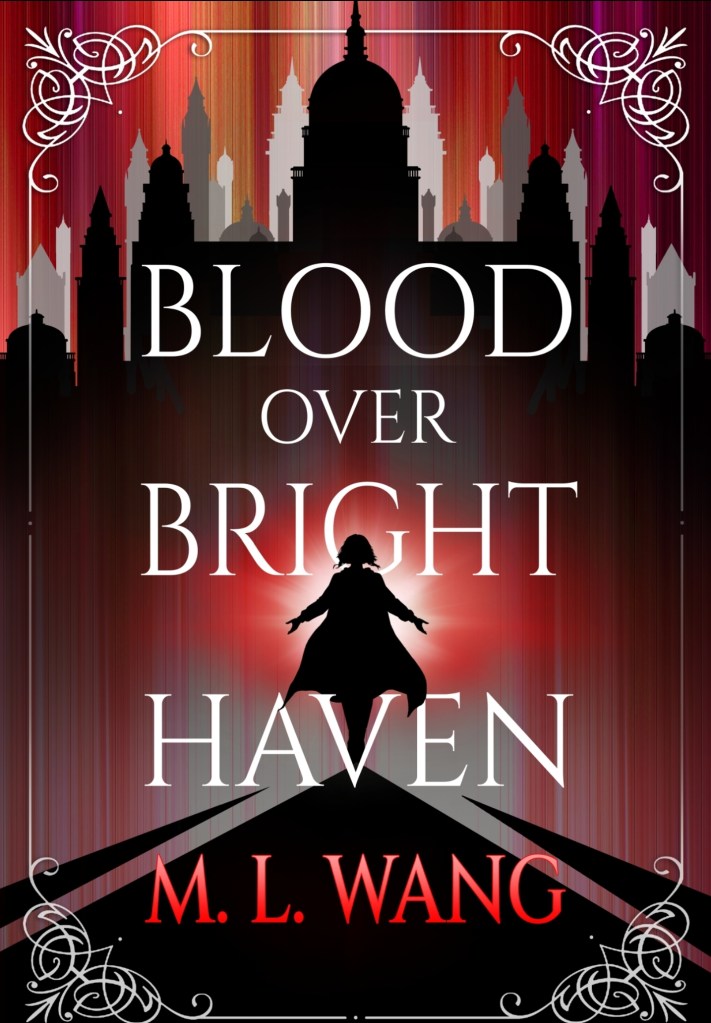
Full warning: you are going to be mildly traumatized by the opening of this book and what happens to the Secondary Protagonist, a hunter named Thomil and his niece, who are the only survivors of their people. The reason why they’re the last is because of a mysterious supernatural event known only as “the blight,” which is a bright light that unravels anything it touches when it appears. The remnants of the tribe are attempting to reach a city state named Tiran, that is said to be free of the blight.
Then you are possibly going to seethe in a combo of rage and anxiety while being Extremely Annoyed with the Protagonist. Then you’re going to get increasingly horrified and worried for the Secondary Protagonist because we don’t meet up with him again for several chapters, and we don’t find out about what happened to the secondary protagonist’s niece until several more chapters. Or at least, that is what happened to me while reading this book.
The Protagonist is a young woman named Sciona who has a lot of drive and ambition to become the first woman “highmage.” Tiranish society is extremely sexist and hold to a belief that women are naturally intellectually inferior. She wants to prove them wrong.
The society is also extremely racist toward the “Kwen,” peoples from outside the city-state’s borders. The Kwen are believed to be barely human and are used as cheap labor. Kwen refugees are often thrown back through the barrier to get eaten by the blight if they aren’t able to work. (Sciona’s lack of *empathy, ignorance and absolute focus on one aspect of oppression is going to make you want to slap her a lot.)
The themes of this novel are about various kind of oppression and privilege. It’s about the way kinds of oppression interact and the way two equally oppressed individuals can be oppressed in different ways while still having “privilege.” Sciona is oppressed by an extremely sexist society that feels her intelligence is “unwomanly.” She is faithful to her religion, which teaches that the Kwen refugees are not actually full people, and this is going to cause some aggravation because it takes literal riots and massacres for her to figure out she’s not the only one experiencing societal oppression. It is painfully realistic.
Thomil is a Kwen refugee who is working as a janitor at the High Magistry where Sciona is to work. He’s assigned as her lab assistant as a “joke.” Through Thomil, she learns about how the Kwen are treated (horrifically) but doesn’t want to believe it, because she initially clings to the idea that the rules of her society are just and fair. (They are not.)
This was excellently handled throughout the course of the story, and the use of unreliable narrator to let you know how a) how extremely oblivious someone who believes racist rhetoric can be and b) how really terrible life is for the poor and for the Kwen.
The writer manages not to do this in a heavy handed manner, and avoids the pitfalls with attempting to write a story about prejudice. (White Savior characters who inspire rebellions or magically fix prejudice and so on.) The pace is slow, and I was extremely impatient to find out what happened to Thomil and his niece however.
Together, our protagonists discover various horrifying things about where the energy that powers Tiranish magic comes from. This leads to Sciona repeatedly trying to reveal the truth, which leads to more horrifying revelations and events. Meanwhile, Thomil keeps patiently trying to explain why Sciona’s ideas to appeal to the morality or reason of the highmages and archmages of Tiran isn’t going to work, and that she’s probably going to get killed. (It takes her a while to understand that the other mages absolutely don’t care about the Horrifying Revelations, because they either know already and don’t care, or have an equally horrifying obsession.)
I was extremely impressed about the way the writer worked concepts of privilege and oppression into the work as discussions/arguments between two equally oppressed people, who are oppressed in different ways. (That are actually similar, though it takesa while for both characters to see this.) Sciona’s journey to understanding the underlying rot of her home leads to an explosive climax that left me in tears. (Sciona makes so many damn mistakes because she desperately wants to believe that the other mages and the citizens of the city are good at heart and will understand that the Thing is Horrible and Want it to Stop. She has apparently never encountered the “I’ve got mine” trait.)
This review is based on a galley received via NetGalley. The review is also for a reprint with a new cover. Sadly, they have the cover at three quarters view, so it doesn’t match previous covers which are at full view.
*There is a difference between empathy and compassion. Empathy is an inborn ability to understand that other people have emotions, and feel a sympathetic response. Compassion is learned via deliberately learning about feelings and how other people feel. It’s based more in thought than emotion. Sciona has almost no ability to relate to others beyond her interests, or on an emotional level, but gains compassion due to her moral code.


Leave a comment