
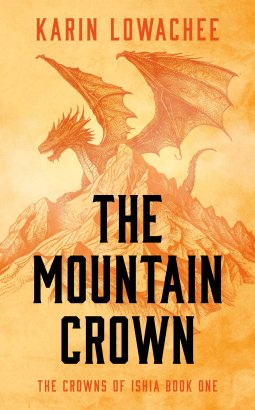
I was wary yet intrigued by The Mountain Crown–mostly because of my general reaction to The Gaslight Dogs, which was brilliant but also a frustrating and emotionally devastating read. (As one would expect about a book about imperialism, entitlement and colonialism. Note: It was very well-written, and basically turned the White Savior concept inside out and then crapped on it–which was a delight, don’t get me wrong–but still devastating.)
The Mountain Crown has a somewhat similar set up, in that it takes place in a setting with colonial/imperialistic invaders and natives who are treated as second or third class citizens in their own land. This time around, the natives tame and manage dragons. Or they would would be able to do this more effectively–because you really don’t want a population explosion of a predator roughly the size of and elephant–if the invader Kattakan hadn’t driven most of them off their land, and forced the remainder to work for them in one way or another.
The Ba’suon have an ability to communicate with dragons. (And a few other implied magical abilities.) Our Protagonist is a young woman named Méka whose traveled all the way from the country where her family has been exiled in order to “gather” a dragon. Unfortunately for her, the local Kattakan lord of the city she arrives in takes her permits and coerces her into hunting a dragon for him. (A dragon that will be slaughtered or forced to fight and then slaughtered.) This is not an ideal situation, but Meka is determined to find a way to get the job done and hopefully save the dragon from the butcher shop.
She’s joined on this mission by Lilley, a slave whose freedom she buys. Lilley, despite being Kattakan has some latent ability to communicate with dragons, and is familiar with Ba’suon customs. (His parents were slaves who fled to Méka’s part of the world. Unfortunately the Kattakan expanded into and invaded Ba’suon lands, so Lilley was eventually conscripted as a soldier, and then ended up in slavery anyway.) She is also joined by one of the Kattakan lord’s men–a Ba’suon man named Raka, who has apparently decided to make his anger, trauma and grief everyone else’s problem. Raka also has some extremely bad blood with Lilley which makes for insane levels of hostility that Méka has to mediate.
This book has some fascinating world building in regards to the dragons–who are called suon by the Ba’suon. The feel I got was somewhere between Anne McCaffrey’s “dragons as horses,” and Jane Yolen’s “dragons being used as entertainment/bloodsport.” That is, in some respects the dragons are “horses” and even come in horse-like scale patterns. (One of the dragons featured is a “piebald.”) Dragons form packs or herds referred to as “crowns” (If I’m getting that part right) and are led by a “king” dragon, who is extremely territorial and dangerous.
The action and interaction between characters is solidly written, and the prose tends toward the poetic. (This is not a bad thing, but may make it slightly confusing if you aren’t accustomed to lovely but indirect descriptions and allusive language.) Méka is an interesting Protagonist, with an inner strength that feels immovable even when she’s in extremely dangerous situations. Both Lilley and Raka are interesting secondary characters, their interwoven backstory and growing relationship with Méka. This was an extremely interesting book and I would like to see more in this setting.
This review was based on a Galley received from NetGalley.


Leave a comment