
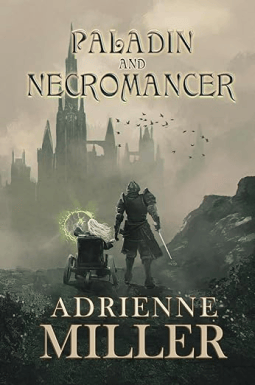
Paladin and Necromancer is fantasy mystery with haphazard worldbuilding and an interesting premise that could have been handled better. Seven years previous to the story planar rifts began opening up and the “enemy” began pouring through with demonic armies and attacking “humanity.” (There is no mention of other countries or of an alliance of countries fighting off the attackers. Also, there’s only one religion and one culture.)
The titular Paladin and Necromancer is Kass, a paladin of Five (the gods don’t have names, just numbers for some reason) and Silver, who ended up going down the Necromantic path during the war. They are married, but their marriage is a less than happy one. Kass’ god is not happy about his continued marriage to Silver, and has been passive-aggressively inflicting petty allergic reactions that slowly escalate on Kass. This has led to conflict in their marriage that they are not able to resolve due to massive trauma and PTSD. (And having diametrically opposed moral systems.)
When demons start coming through the rifts, apparently bent on assassinating important figures from the war and the king, Kass and his wife end up investigating who is sending the demons. This investigation leads them to other planes where they discover among other things, Magic Kaminoans. (The genetic engineering slave traders from the Star Wars franchise, who created the clone troopers.)
My beefs with the worldbuilding kept me from finding much interest in the plot. The writer does not know how polytheism works. This is not surprising, since this book has been described as “like a D&D campaign,” but it’s particularly egregious here because the big existential horror b-plot is “what if the gods were also on the enemy’s side?” This is apparently such an unthinkable thought that all the characters are shocked by it.
In a polytheistic system, everyone is very, very aware that a god’s favor might shift at any moment, for any reason. They would not be very surprised at the idea that the gods were also with “the enemy.” Syncretism is also very much a thing. As an example, the Romans tended to go “Well, this god is obviously actually Mars, and this god is actually Mercury!” They also tended to collect gods like they were Pokemon. (Though I might let the characters off slightly because apparently “the enemy” is visibly non-human.)
The book gets some points for some subtle non-binary representation in that one of Kass’ squires is referred to consistently as “them/they” but the weird mix of technological and social advancement and the kind of “crapsack medieval social system and tech level” setting that you see in in certain fantasy franchises is jarring. (I solemnly swear that the “medieval” period was not as brown and rolled in mud as Hollywood apparently thinks.)
The premise and the characters were not enough to hold my interest in the plot or characters interactions which is a shame, since I feel the concept could have been an interesting one. (I was largely drawn to the book because of The Grandmaster of Demonic Cultivation, because the lead characters are essentially also a necromancer and a paladin solving a really convoluted case fic. But this was not that.)
This review is based on a galley provided by NetGalley.


Leave a comment