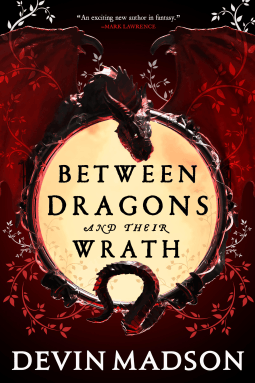
I have some complicated feelings about this book. On one hand, it’s extremely well written, with some fascinating worldbuilding. On the other hand, the Protagonists are trashfires and I want to strangle them a little bit. (Silver lining: I am very engaged in reading. Lead lining: these people are trashfires.) This book is split between three characters, Tesha, an apprentice glassmaker with revolutionary leanings, Ashadi, a noble exiled to “The Shield” to be a dragon rider fighting monsters, and Naili, who is a laundress.
These three people are absolute disaster people who are tied to metaphorical train tracks, and in the distance, you can hear the train. The setting involves a nation attempting to “unify” the city states of a region referred to as “the basin.” There are some severe culture clashes between the Emorans and the “Apaians” who are native to the region. There’s also a third group, called Lummazzt This war is mostly over a resource called “scale” which is mined, and used to make scaleglass–a kind of glass that is stronger than steel and considered absolutely shatterproof.)
Our revolutionary Tesha, a citizen of the city state Learshapa, agrees to be an “insult bride” in some complicated bit of Emoran politics. She has been told that this will lead to getting an Emoran ruler who will respect the independence and cultural ways of her city state. (Considering the Emorans are incredibly imperialistic, and actively engage in assimilation and cultural destruction, this does not seem likely.) Her ex-boyfriend is not happy about this.
Ashadi, our exiled noble who fights monsters, encounters a human where no human is supposed to be. A man who is somehow able to shoot a bullet through a scaleglass scale. Ashadi is full of privilege, and is kind of thoughtless. He is also is coming down from being addicted to various drugs, at least one of which he needs to be able to ride his dragon in the first place. Oh, and he’s been framed for deserting, because he Saw Something He Shouldn’t Have. He continues to Learn Things He Shouldn’t as the plot progresses.
Then there’s Naili, who is a laundress in the household of an alchemist. Her life is kind of miserable and her job needs to be unionized because she’s being beaten and starved for all kind of infractions. Unfortunately for her, close contact with the alchemist’s chemistry experiments (via having to clean contaminated cloth) leads to Naili acquiring mysterious abilities involving plants. Mysterious abilities that may kill her eventually. Her desperation to find a cure before the contamination runs its course leads her to doing Extremely Stupid Things that will probably kill her faster.
The main connections between these characters so far is that Ashadi is the older brother of Tesha’s ex-boyfriend. In turn, Naili’s brother Mana is Ashadi’s “watcher,” a kind of attendant who administers the various drugs a dragon rider needs. (Ashadi and Mana have a painfully fraught relationship that is its own fascinating disaster to observe.) The three protagonists don’t do very much interacting. It’s very much as if there are three novels happening simultaneously, which is a very interesting effect. (It feels much more pronounced than other books that also have multiple pov characters. I think this is because in each storyline, each character is very much The Protagonist.)
My mixed feeling about the book can be attributed to the “human disaster” aspects of each of the protagonists. There is also the amount of trouble they are each diving into without much in the way of consideration for the actions. Tesha doesn’t consider what might happen to an “insult bride” when she’s discovered, Ashadi manages to get himself into increasingly hot water when he walks into a trap, and Naili…is Naili.
There are some attempts at humor, but the attempts tend to fall flat for me. (They may not for someone else.) This book tends toward the “grimdark” with several disturbing revelations and implications. (This book can contain so much fridge horror!) There are also some thoughtful meditations on the effects of imperialism, assimalation, and what happens when a people’s culture is destroyed. (And manages to do this in a simple, in-character voice way.)
This review is based off of a galley from NetGalley


Leave a comment