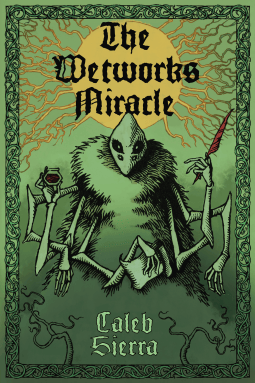
Fun Fact: this book was a very fast read, but it was several days before I could get my wits together enough to write the review.
The reason? It’s probably the creepiest and most grotesque horror novel I’ve ever read. (And I say this, having read the original short story by Steven King that became the movie Children of the Corn. A short story that always, always makes me nauseous.)The writing is solid, with lots of interesting themes. (Somehow I ended up reading another book about colonialism and why capitalism is not really all that great again.) It’s also deeply disturbing on multiple levels, and has so, so much body horror.
Our setting is a human colony eking out a miserable existence on a world with only one plant, that they call the Root. A plant that has over-run and out-competed all other plants by mimicking them. It’s also sapient, and has certain designs upon humanity. Designs that if the humans knew about them, they would find extremely appalling. (You could say that the Root is the opposite of the computer in Harlan Ellison’s “I Have No Mouth And I Must Scream,” in the sense that instead of hating humanity, it thinks that humanity is just the Neatest Thing Ever.)
The anti-colonial and anti-capitalism themes show up from the beginning. The colony are the descendants of refugees from a world they actively used up and destroyed. It’s implied they’ve done this several times, making use of all the resources in a given planet, including the “natives” and then the upper classes jump to the next world, leaving the rest behind to die of the apocalypse they caused. Their current religion is based on a transactional relationship with god, where the priests are literally accountants, and everyone is essentially indentured to god (and also, the state).
This time around, things are not going as they usually do. Due to the Root’s ability to mimic and out-compete any plant introduced, the human colony becomes dependent on the Root for food, shelter, and even clothes and medicine. (The only animals that survived were the humans.) Various settlements intended to propagate and extract resources from the Root are scattered all over the planet. Each settlement is controlled by a “Husband” who is the director of whatever resource is being extracted. The Wetworks is a settlement that processes waste from the Root into fertilizer.
It’s clear that the humans believe that this is their normal sequence of “use a planet up until it’s ruined then escape to another world,” but it slowly becomes apparent that this is not the case. Instead, it slowly becomes apparent that the Root is the one taking advantage of human labor and ingenuity, with the humans being for the most part completely ignorant that they’re not really in control…that is until a horrific accident at the Wetworks results in a bizarre “miracle” where certain revelations occur.
The Wetworks Miracle is dark, full of body horror and fridge horror. It pulls you along through an inhumane horror of the human society of this book, to the inhuman curiosity and interest of the Root and the native “Beast Scholars.” (Honestly, I was more sympathetic toward the Root than I was for most of the human characters. Humanity is not an innocent victim in this book. Their society is extremely toxic and corrupt, and it’s broadly hinted, then outright stated that humans have enslaved, then biologically engineered the sapient natives of previous worlds to make them more “useful.”)
This book is excellent and absolutely brutal. I am probably not going to read it again, because it was just that disturbing. However, if you are a fan of body horror, weird fiction–in the sense of that mix of science fiction, fantasy and the paranormal that makes up the Cthulhu Mythos and other works of cosmic horror–then this is definitely the book for you.
This review is based on a galley copy received from Netgalley!


Leave a comment