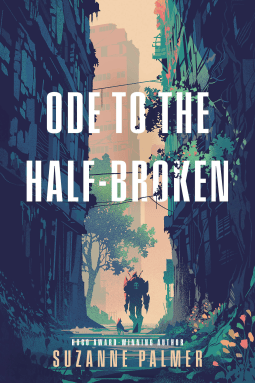
It’s the post-apocalypse and a nameless military mech wakes up in a tub after a malware attack, missing it’s leg. Our nameless Protagonist embarks on a quest to regain its leg and hire a mechanic to repair it. (The mech is an original model, and there are no modular parts that will fit. Why it’s an original model, and who created it is slowly revealed throughout the novel.) Our Protagonist acquires companions who become friends over the course of the journey. Meanwhile, the search for its leg becomes a quest to find out who is sabotaging the hard-won peace between humans and mechs.
The setting of Ode to the Half-Broken takes place more than a hundred years after a series of wars, mech civil rights and an environmental collapse. Free mechs and humans live human only, mech only and mech-human communities, most of them working on cleaning up the environment. Unfortunately, there are also “worktowns” where would be warlords rule over populations that are more or less under guard to keep them from escaping. The worktowns would of course be the usual suspects (and they are certainly not helping) but the situation turns out to be a lot more complicated.
Our Protagonist is an interesting character, and this is very much a story about forming connections, rebuilding and creating a better world. Protagonist goes from an isolated, misanthropic person whose interests in the real world is limited to its study of social insects. (Specifically, ants.) From there it makes the acquaintance of a cyborg dog, other mechs, and humans. It makes friends and goes on little emotional journeys as it deals with its past and the part it played during the various wars.
The overall tone of the book is a mix of humor, adventure and drama. The characters are interesting, and the worldbuilding extremely “natural.” That is, in the sense that we can see the line of progression from start to end result. In a lot of sf/f the cultural or other worldbuilding detail is just dropped in there with no explanation on, “and how exactly did we get here?” This is particularly jarring in settings that are near future or within a couple hundred years of present day. Note: I am specifically talking about cultural shifts, customs, and so on. A story from the seventies that didn’t predict instant messaging isn’t going to be a surprise. What is surprising are some of the societies/cultural shifts writers come up with, that just don’t make sense. This is not the case here. “Why” and “how” are interwoven into the story and we can see how the progression occurred.
This was a great book, and I enjoyed reading it. This review is based on a galley received from NetGalley!


Leave a comment