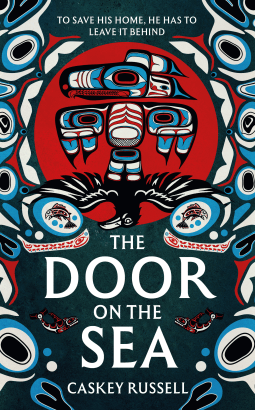
Okay, hear me out here. Take a Western-style quest fantasy in the vein of Terry Brooks’ Sword of Shannara or Eddings’ The Belgariad. The standard “Chosen One, Quest Object, Evil One,” doorstop fantasy that is supposedly derivative of The Lord of the Rings, but isn’t really. (Not enough constructed language geeking for one thing. Too much Monomyth for another.)
Skin it. Stretch the hide over a frame built on Tlingit culture and folklore–and you will have something possibly resembling The Door in the Sea. (As long as you remember to stick in the elements that are actually judging the conventions of said doorstop fantasy, the constant obnoxiousness of the raven, and the continuous kvetching about a. the raven being rude b. the protagonist Elān being a book eater c. the raven getting mad because he can dish it but not take it d. Elān not being a warrior e. the raven not doing his job f. Elān wanting to be a warrior and then feeling conflicted about wanting to be a warrior g. the raven existing and breathing the same air as the crew.)
Elān is a young man in training to be a teacher. His grandfather was a famous warrior, and this is one of the reasons why the elder Ixt has Elān lead the expedition to locate the Quest Object. (That, and the raven tried to bribe Elān with the Quest Object after he gets caught trying to steal salmon.) There are of course a number of problems with this from the beginning:
- Elān has a lackadaisical personality that does not lend itself to authority positions.
- Warriors as may be implied by the term “bookeater” do not think very well of teachers or other members of the Longhouse of Service and Trade.
- The raven won’t do his job, which is translating. This is a very serious problem, since one of the party members is a wolf, and no on speaks wolf. (Fortunately, the wolf understands their language. So they are at least able to communicate somewhat.)
- Several members of the crew spend a lot of time trying to get Elān to step down as the expedition leader.
- Elān’s inexperience leads to damage to the canoe, almost getting captured and other events.
The Quest Object in this novel is a deadly weapon belonging to the shapeshifting Koosh. This weapon, called a dzanti, ended up at the bottom of a bay, and the crew has been sent to retrieve it. Retrieving this weapon may be the only way that Elān’s people will be able to defend themselves from the Koosh, who are beginning to invade the islands and mainland.
What draws the attention the most with this work is the narrative style. The narrator is very much a capital N Narrator and is almost a character in their own right. The Narrator tells the story in a slightly rambling fashion with the occasional side trip to explain things. (I would call it “As You Know, Bob, but the Reader is actually Bob here, and this Reader genuinely did not know.) The general feel here is that you are settled down somewhere, listening to this storyteller.
This is a solid epic fantasy with a lot of thoughtful things to say beneath the surface. (Mostly about “warrior” cultures that don’t approve of intellectualism. And how intellectuals from warrior cultures don’t quite approve of themselves either. Elān wants to be a warrior–because he doesn’t want to be a teacher. Yet for him, there’s only those two options: be disappointing or being disappointed.) I am looking forward to seeing where this story goes.
This review was based on a galley received from NetGalley.


Leave a comment