

I am already doing the 20 Books meme, but the meme doesn’t let you explain why the book influenced you. (I have however had some interesting conversations related to the meme, so there’s that.) So this is a good opportunity to plug books that have for one reason or another lived rent-free in my head.
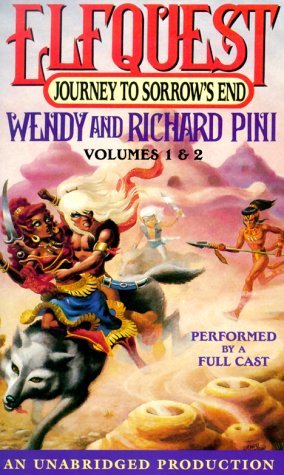
I first read ElfQuest: Journey to Sorrow’s End as a novelization. I was not aware that it was actually a comic book until I saw the Marvel Comics edition of ElfQuest. I fell hard for the characters and the story, and collected the comic book and also the anthology that came out in the eighties. I came up with storylines for adventures within the setting and attempted to create art based on Pini’s style. (As a kid I drew a lot. Not well, mind you, but I did like to draw.)
ElfQuest: Journey to Sorrows End has a pretty simple storyline, that slowly gains complexity. We start with and elf tribe called Wolfriders, who are attempting to rescue one of their fellows from humans. This rescue attempt leads to the burning of their home, and further betrayal at the hands of their neighbors; they are led into a tunnel that leads to a desert.
With no way to go back, the Wolfriders are forced to cross the desert, which eventually leads them to another elven community. Which they promptly attempt to raid, because they don’t think the Sun Folk are fellow elves at first. (Kid me didn’t care, but Adult me finds this Questionable.) This leads to Cutter, the chief of the Wolfriders “Recognizing” the Sun Folk Healer Leetah. (That is, Recognition is a biological imperative to reproduce.) Wolfriders tend to view this as an absolute, the Sun Folk have rituals meant to resolve conflict in cases when the couple that Recognizes each other can’t get along. Which is very much the case at first, since Cutter manages to accidentally kidnap Leetah during the raid. And yes, it was accidental: no thought, head empty. This is the not the water jar I was trying to steal, this is a girl.
I feel that the first four major arcs/collections are the strongest and the best in regards to plot, characterization and theme. However, later arcs are bogged down by a failure to say anything new, and peculiar worldbuilding decisions that eventually drove me from the series. (I am extremely cranky about the thing where humans are almost always the bad guys especially if they have a religion. There are also Other Issues.)
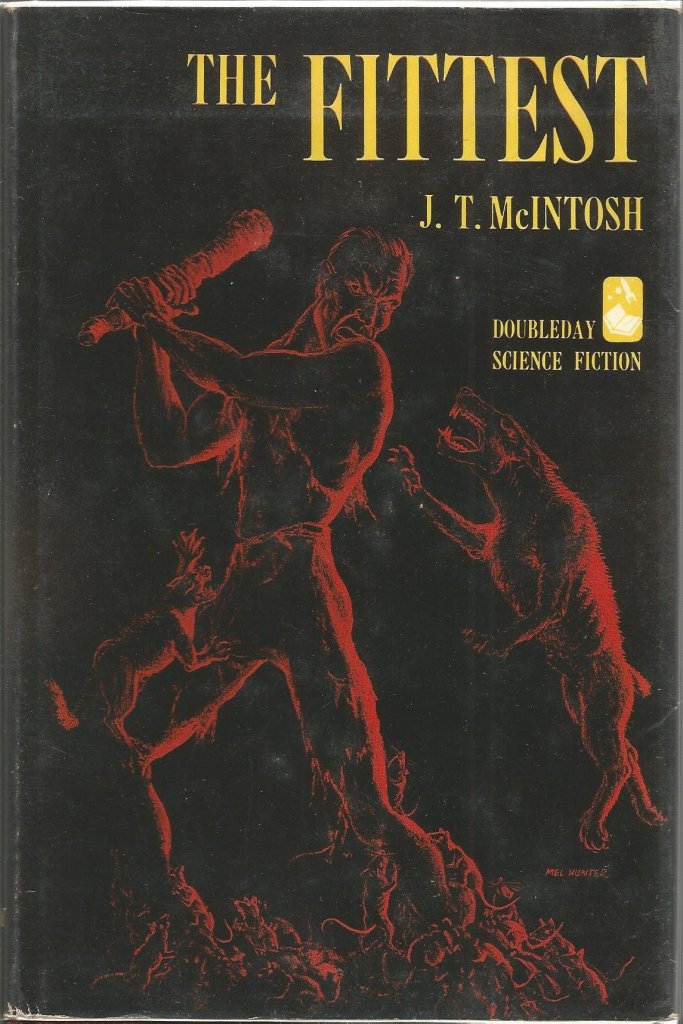
The Fittest, also known as “The Rule of the Pag Beasts” by J.T. McIntosh is a book that lives rent free “despite” instead of “because.” J.T. McIntosh is a violently misogynistic writer with an extremely misanthropic view of humanity, which shows up very strongly in his work! This apocalyptic story is very much an allegory about how humanity is red in tooth and claw, with only a small percentage of people capable of civilization.
In this setting, a scientist’s experiments lead to intelligent animals that are apparently filled with a malicious intent that causes them to turn on humans. The intelligent animals are successfully able to destroy human infrastructure, though not necessarily in a planned, strategic fashion. (The intelligent animals all predate on each other when they aren’t randomly murdering humans. They also have limited ability to communicate with each other, or pass on information, which are apparently their only weaknesses.)
One of the first scenes is the Protagonist speculating on the horrific death of his wife, who was first tormented by intelligent mice, and then murdered by a tom cat. This is some pretty graphic content, but the ghoulishness of this novel dragged me along even as I screamed, “Why do you keep equating cat behavior to women and dog behavior to men?!” And, “That is absolutely not how an intelligent dog would act, and I assure you that intelligent horses would be death on four legs.” (Supposedly the intelligent horses were destroyed by the other animals. This is not likely. Regular horses are a collection of paranoid neuroses barely held back from exploding to begin with. A band of intelligent horses would be extremely organized and able to defend itself.)
This is a book that lives with me, because I argue with it. This book lives rent free because I have elaborate plot lines involving intelligent animals that actually act like animals instead of allegorical representative of the inherent inhumanity of man toward their fellow man. This is also a book with one of the most predictable twists imaginable. Still, the book is readable if you’re willing to hold your nose at the off hand contempt and objectification of women.
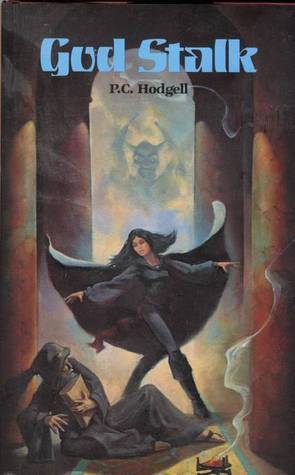
Godstalk by P.C. Hodgell is a book I have been fangirling since I first read it in high school. The writing is lush and incredibly dense, in the sense that a lot of information is packed in a few lines. The narrative is a little wry, with a combination of poetic description, and a dark sense of humor. I tend to prefer the earlier books to the most recent, though they also have their moments. (I loathe the later covers which are all kind of terrible and aggravatingly inaccurate in regards to the Protagonist’s appearance.)
The book opens with Our Protagonist, a young woman named Jame, being pursued by undead monsters called haunts. She flees to a city that seems almost deserted–only it’s not deserted, she later discovers. The entire city population was in hiding do to it having been The Feast of Dead Gods, and they wanted to avoid becoming one. This turns out to be a Problem for Our Protagonist, because she is a monotheist, and the revelation that there might be other gods is earthshaking.
So she does the most obvious thing, and begins to experiment on the city’s gods. You know, as you do. She also stumbles into becoming a thief, despite being from an extremely honor-bound culture, gets involved in a “illegal” trade war, and nearly burns the whole damn city down, all while learning more about a past she doesn’t quite remember.
This book is a brilliant deconstruction and reconstruction of many familiar themes of fantasy. We have endless wars against the Powers of Darkness. We have complicated politics in a corrupt and decadent city. We have a Thieves Guild. We have a possible Chosen One and a Quest. But all of these things are slightly sideways from expectations. Hodgell plays with familiar tropes and turns worldbuilding details into discussions of ethics, power, and agency. I love this book and it’s sequels, though again, the later books are not as strong as the earlier books.


Leave a comment