
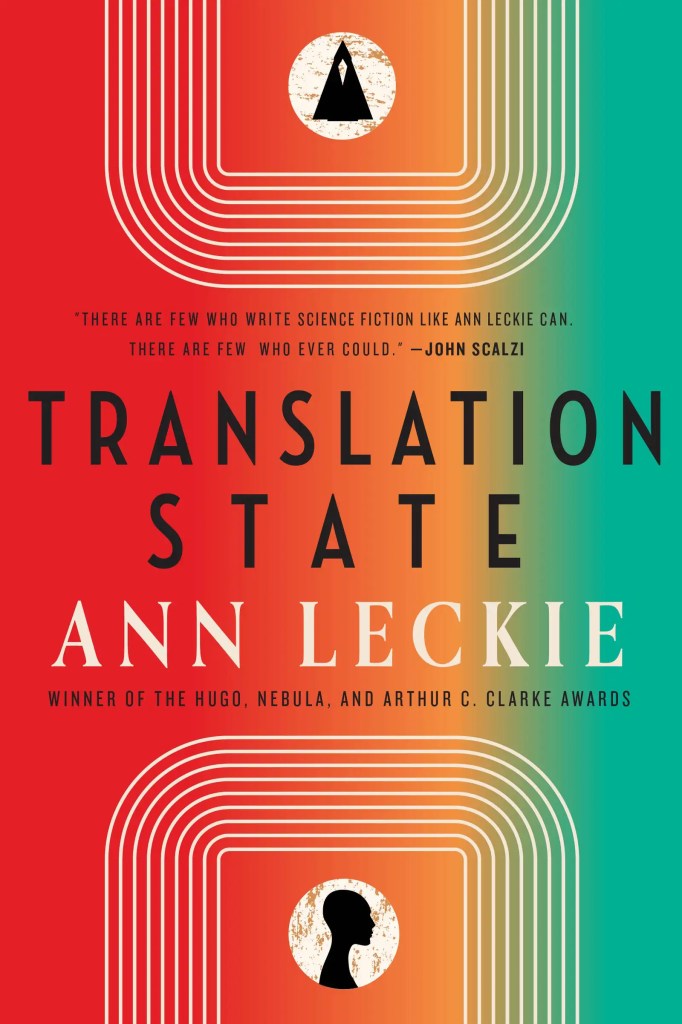
Reading Translation State was a trip, and this review is going to be pretty spoilery! I am a big fan of the Imperial Radch Trilogy, and Translator Dlique from those books was one of my favorite characters. (She was so interesting and also so very very alien.) It is hard not be curious about the extremely Eldritch Presger and their equally weird Translators, and Translation State gives us a lot of information that the reader may or may not be confused by because Translators are very, very weird.
The point of view is split between three characters. Esae, who is from a well-to-do and very toxic family who is essentially assigned a make-work job as a investigator to get rid of sie after the death of hir grandmother. (I’m stating this a little harshly. The situation is actually more complicated. The grandmother had made an arrangement with a nouveau riche entrepreneur where the entrepreneur would support the grandmother, and on the grandmother’s death, the entrepreneur would be adopted as the grandmother’s daughter and heir. The situation is unfair, but part of the arrangements made are to ensure that Esae will be given support. The entrepreneur however does not want a roommate, and does not need Esae to fulfill the caretaking/support role sie was previously in.) The investigation is to find a missing Translator. Said Translator has been missing for two hundred years and this is a very cold case. Of course, Esae, being a very responsible person decides to take the investigation seriously.
Then there is Reet, a young man with few prospects and fewer interests outside of a favorite adventure program. (And dumplings.) Reet suffers from violently intrusive thoughts but has never acted on them. (Except for a few Biting Incidents when he was a small child.) Reet ends up in some difficulty due to being approached by a disenfranchised minority group that may or may not be connected to terrorism/insurgency. (They are in fact trying to fight for their rights and their culture because another group is committing atrocities on their ethnic group.) The Hibiki believe that Reet is a member of the minority’s long-lost ruling class. His new connections with the minority community nets him a job as a assistant/guide for visitors. Then he ends up in even more difficulty when he meets up with Esae in his role of Local Guide. (Interestingly of the three characters Reet is the only one with a loving, accepting family. Which is possibly a major reason he’s so well adjusted, considering.)
It turns out that Reet is a descendant of the missing Translator. (It also turns out that somehow, the Translator’s offspring ended up the ruling class of a space station polity.) This is not an ideal situation for anyone concerned and this causes a great deal of conflict and highhanded behavior from the Radchaai Ambassador, who essentially kidnaps Reet. (There is a teeny tiny bit of validity to the Ambassador’s actions. Juvenile Translators tend to act on their very, very violent intrusive thoughts. There are also other reasons that quickly become clear. The Ambassador is still a pretty terrible person though, and it’s pretty clear that no one on the committee she’s on likes her very much…and with good reason. Seriously.)
Finally, there is Qven, a young Translator who has had a number of extremely traumatic experiences. (Most of them related to the way e was raised and finding out about the Translator Birds and Bees in the absolutely worst way possible.) This lands e in a vast amount of trouble due to being judged as “not optimal” after ruining e’s prospects. E’s last chance to make good and become useful to e’s clade is for e to “match” with a long lost member of e’s clade. (In other words, Reet.) Through Qven we learn a great deal about Translators and their interface with the Presger.
In the background of the story is the ongoing efforts of the artificial intelligences in the Republic of Two Systems to be recognized as Significant Beings. (That is part of the treaty the Presger have with humans and a few other sentient species that keeps the Presger from playing Operation on them.) We get a cameo from Sphene, who is brilliantly cutting and sarcastic, and therefore is a delight. Dlique, is mentioned but does not make and appearance. (Much to my disappointment. On the other there’s every indication that Dlique has a Friendship with Sphene and I find this weirdly adorable.)
It should be noted that this is not what you could call a “casefic,” appearances to the contrary. Instead, much like Provenance it’s a study in human/non human interactions with a focus on kinds of family and ways of raising children into adults. One of the major points of the work is the way Translators because of and for the Treaty. They are a midpoint between humans and the extremely Eldritch and possibly multi-dimensional Presger, and their behaviors and actions combine those inherent traits. (The details of which were extremely fascinating!) This was a very engaging book, and possibly the weirdest “will they or won’t they?” ever.


Leave a comment