
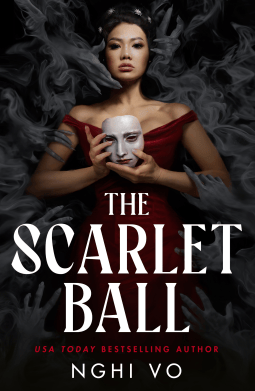
In The Scarlet Ball, a young half-Vietnamese, half-French woman stumbles into an opportunity that could very well be the death of her. Judith Ban is a recent immigrant living in Manhattan and working for a very exclusive modiste. (For long hours and crappy wages, as this is taking place during the 1800s when everything was terrible for everyone, and yet somehow even more terrible if you were not white.) Our Protagonist is doing a delivery to a mansion that is in disarray: the young lady of the house has absconded in order to avoid a potentially lethal social obligation.
Judith is offered a job offer she probably can’t refuse: to impersonate Iphigenia Howard for the up coming high society season. The lethal part of the season is that she will be expected to court powerful elemental gods (or demons). If she can make it through the season until Iphigenia is found, she’ll be set for life: she’ll gets a large sum of money and a house in another city.
Judith, convent-raised but subsequently ending up a sex worker in Paris before coming to the States is able to manage the impersonation. (That is, she has manners and an education. Also, she can lie convincingly, and dance. She still ends up in debutante boot camp under the stern eye of Mielle, an entity under the control of Mrs. Howard.) She is not exactly thrilled by the situation: part of her disguise is a mask made from the face of a Howard family bastard, she’s expected to court elemental demons and her current boss is literally a witch. At the same time, she is stubborn enough and strong enough to cooperate despite the increasingly dangerous situation, especially with the reward on offer.
Our Protagonist manages to survive her first ball, and it turns out, has acquired the attention of a storm. (Something that’s never happened, according to the records painstakingly written by the coven.) Our Protagonist remains unsure as to whether she want’s anything to do with this situation, because these elemental/demonic entities tend to consume whatever they’ve fallen in love with. (And therefore, a woman who’s managed to catch and marry one of these entities has to find them replacement meals or end up on the menu.)
The worldbuilding in The Scarlet Ball is top notch, with lots of eerie, haunting images. It uses those images to facilitate a narrative that has a lot to say about class and race within this historical setting. Our Protagonist does not hold back on her feelings about being non-white in a culture in which segregation is a given, or about the restrictions this creates. Her anger and fear propels her a good way through the plot, tempered only by her conflicted feelings for the storm that’s fallen for her, and her otherworldly lady’s maid Mielle. The Scarlet Ball is a fascinating combination of social commentary, dark romance, and historical fantasy that does not flinch from or avoid the complexities of the historical setting. (There are also some amazing twists. This a story that will drag you along with it to the very end.)
This review is based on a galley copy received from NetGalley.


Leave a comment